Niagara Falls from both sides — and wandering on into Canada
Three waterfalls, two countries, one river, and a whole country waiting beyond the gorge.
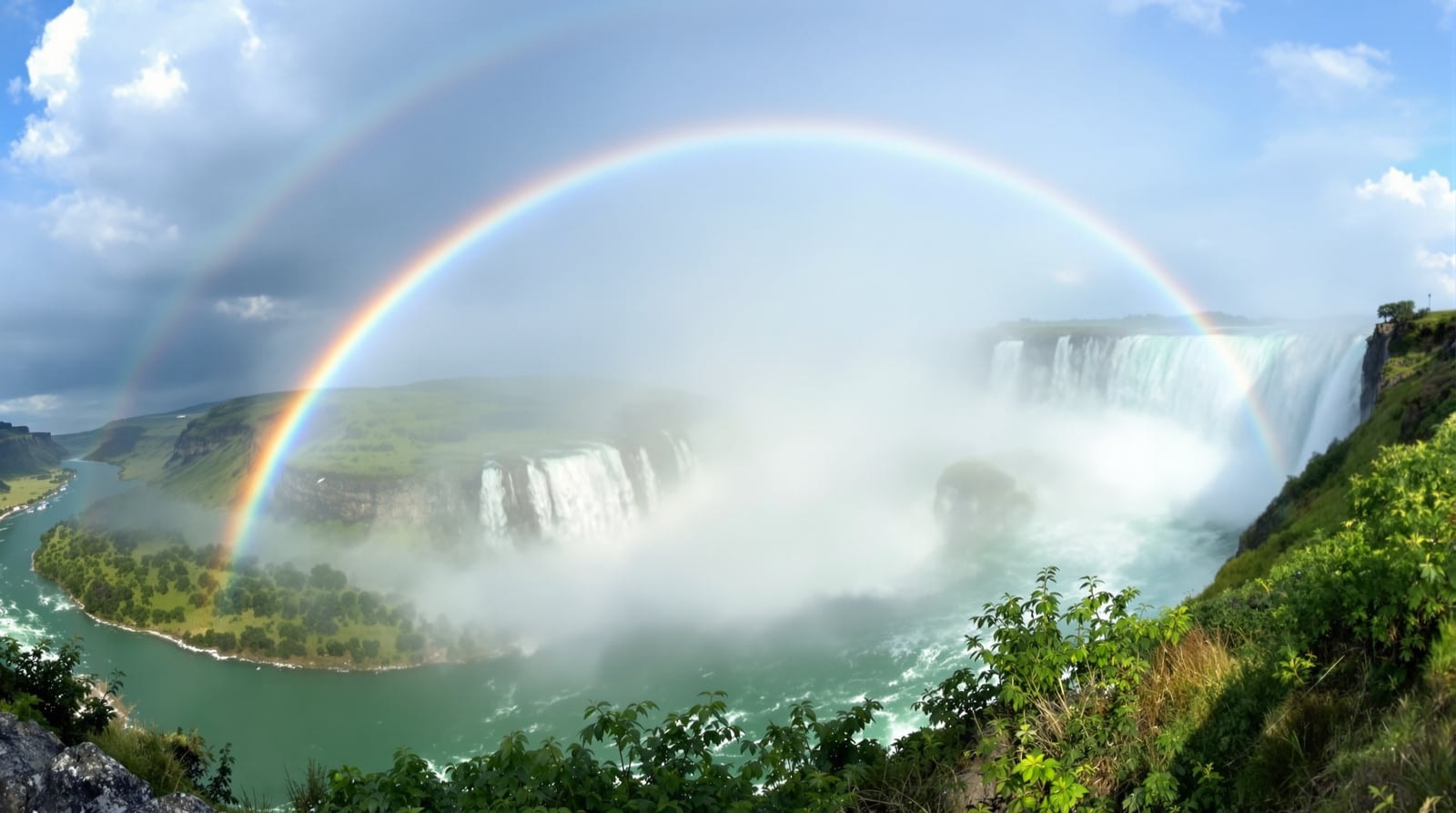
Niagara Falls has been photographed so often that it is easy to assume you know it already. Then you stand at the brink, feel the ground hum, and get soaked by spray on a sunny day, and the postcard falls away. The falls sit on the Niagara River, on the border between New York State and Ontario, and seeing them properly means seeing them from both sides.
Three falls, not one
What most people call Niagara Falls is really a group of waterfalls. Wikipedia's article on Niagara Falls describes three individual falls, the American Falls, Bridal Veil Falls and Horseshoe Falls, with the Horseshoe Falls the largest of the three and straddling the international border. The river then plunges on into the Niagara Gorge, a steep-sided channel that carries the water north toward Lake Ontario.
Knowing the layout helps you plan. The American side puts you close to the smaller falls and the rapids above them, with islands and footbridges that bring the water almost to your feet. The Canadian side looks across at the whole curtain of water at once, with the great curve of the Horseshoe Falls in full view.
The American side
On the New York side, the pleasure is intimacy. Paths wind through parkland along the upper river, where the current races over rock shelves toward the drop, and small islands between the falls let you stand between two channels of roaring water. It is a place for walking slowly, reading the water and watching how the mist changes with the wind.
The Canadian side
On the Ontario side, the pleasure is the panorama. A long riverside promenade runs along the top of the gorge facing the falls, and at night the spray catches colored light. The parkland along this side of the river is looked after by a public agency; Niagara Parks describes its stewardship work as protecting the natural wonders of the Niagara River corridor, including the forest canopy, species diversity and shoreline management. Beyond the busy stretch opposite the falls, that corridor is surprisingly green, with gardens, woodland and trails.
Crossing between the two
A bridge links the two sides, and walking across it is one of the simplest ways to see the falls from above the gorge. It is also an international border crossing. Identity documents and entry requirements for each country change over time and depend on your nationality, so check the official government guidance for both countries well before you travel, and carry what they ask for.
The gorge and the river paths
Most visitors never leave the few hundred yards closest to the falls, which is a shame. Downstream, the Niagara Gorge becomes a wild place of whirlpools, rapids and boulder fields, with trails that drop toward the water and paths that follow the rim through woodland. Upstream, the river is broad and calm, lined with parkland and small towns. A day spent walking or cycling the river paths shows Niagara as a living river rather than a single spectacle.
- Wear shoes with grip. Spray makes rock, steps and boardwalks slippery.
- Bring a light waterproof layer for viewpoints close to the falls.
- Stay behind railings and on marked paths; the river is powerful and unforgiving.
- Visit early in the day or in the evening to see the falls in softer light and with fewer people.
Wandering on into Canada
Niagara makes a natural doorway to a longer journey through eastern Canada. A few directions to consider:
Toronto
Canada's largest city sits on the shore of Lake Ontario, a patchwork of neighborhoods with their own markets, food and festivals. It rewards walking, especially along the waterfront and through its older districts.
Montreal
Farther east, Montreal mixes French and English, old stone streets and modern design, with a mountain park at its heart. It is a city of cafés, markets and long summer evenings.
Quebec's parks
Beyond the cities, the province of Quebec opens into forest, lakes and river valleys. Its provincial parks are the place for canoeing, hiking and autumn color, and for a sense of how vast the country really is.
The Ontario wilderness
North of the populated lakeshore, Ontario becomes a land of granite, pine and countless lakes. Paddling routes, quiet campsites and loon calls at dusk are the reward for traveling light and planning carefully.
If waterfalls are your thing, the page on local travel and exploring close to home has more on chasing falls in state parks, and the train travel tips are a good companion if you want to cross Canada by rail rather than by road.